
Lightweight Family Backpacking Tent: Carry More, Worry Less
Find the ideal balance of space, weight, and durability for your family's next backcountry adventure.
Start Your ResearchWhy a Lightweight Family Backpacking Tent Changes Everything
Backpacking with your family is one of the most rewarding ways to disconnect and reconnect. But the wrong shelter can turn a dream trip into a slog. A lightweight family backpacking tent is the cornerstone of a successful adventure. It keeps your pack manageable, your setup stress-free, and your family comfortable after a long day on the trail. This guide is designed for parents who are past the "car camping only" stage and are ready to venture deeper, but who refuse to compromise on space or safety.
We will walk you through the critical trade-offs: interior space vs. packed weight, durability vs. packed size, and easy setup vs. weather protection. By the end, you will know exactly which features matter most for your family's specific needs, budget, and typical terrain.
The Core Trade-Off: In a family backpacking tent, every ounce counts, but so does every square inch. The goal is not to find the absolute lightest tent, but the one that best balances weight, living space, and durability for your crew.
Key Features to Evaluate in a Lightweight Family Tent
When you are researching, you will encounter a lot of jargon. Let's break down what actually matters for a family on the move.
1. Capacity and Interior Space
Tent capacity is usually listed as "X-person," but this is a maximum, not a comfortable guideline. For a family, you should look for a tent that is rated for at least one more person than your group size. For example, a family of four will be far more comfortable in a 5- or 6-person tent. Look for near-vertical walls, which dramatically increase usable space. A tent with a peak height that allows adults to sit up comfortably is a game-changer. For a deeper dive into sizing, see our guide on how to choose tent size.
2. Packed Weight and Trail Weight
This is the most critical factor for backpacking. Manufacturers list two weights: "packed weight" (everything that comes in the box) and "trail weight" (tent body, fly, poles, and stakes—excluding stuff sacks, footprint, and instructions). For a family tent, you should focus on the trail weight. A good target for a lightweight 4-person tent is under 10 pounds, and for a 6-person, under 15 pounds. The weight is distributed among family members, so a 12-pound tent split between two adults is only 6 pounds each—very manageable. Always check the packed size as well, as it needs to fit into or strap onto your backpack.
3. Setup and Takedown
After a long hike, the last thing you want is a complicated puzzle. Look for tents with color-coded poles, continuous pole sleeves, or clip-on designs. Freestanding tents are easier to set up on rocky or hard ground, as you can move them into position before staking them out. For families with younger children, a tent that can be set up by one person quickly is a huge advantage. You can find more tips on easiest 4-person tent to set up.
4. Weather Protection and Durability
A lightweight tent should not mean a fragile one. Look for these key specs:
- Fly and Floor Material: Ripstop nylon or polyester with a polyurethane (PU) coating. A hydrostatic head rating of at least 1500mm for the fly and 2000mm+ for the floor is a good baseline for three-season camping.
- Seams: Taped or sealed seams are essential to prevent leaks.
- Poles: Aluminum poles (like DAC) offer the best strength-to-weight ratio.
- Ventilation: Mesh panels and vents reduce condensation, which is crucial when multiple people are sleeping inside.
5. Doors and Vestibules
Two doors are almost non-negotiable for a family tent. It allows for easy access without climbing over sleeping family members. A good vestibule provides a protected space for storing muddy boots, backpacks, and other gear outside the main sleeping area. This keeps the interior clean and clutter-free.
Choosing the Right Tent for Your Family's Style
Different families have different priorities. Here is how to align your needs with the right type of tent.
For the Ultralight Family
If you are covering serious mileage, every ounce matters. You will be looking at premium, high-end tents that use the latest fabrics and pole designs. These tents are often more compact and may have slightly less interior volume, but they are a joy to carry. They are an investment in your family's backpacking future. For a benchmark, see what lightest freestanding 1-person tent technology can teach us about weight savings that trickle up to family sizes.
For the Comfort-Focused Family
If your priority is a happy, well-rested family, look for mid-range tents that offer more livable space. These might be a pound or two heavier but often feature taller ceilings, more mesh for stargazing, and larger vestibules. This is a great balance for families who do a mix of backpacking and car camping. You can also consider a waterproof family tent for camping that is designed for basecamp use but can be carried short distances.
For the Budget-Conscious Family
You do not need to spend a fortune to get a great backpacking tent. Entry-level and budget-friendly tents from reputable brands can serve you well for years. They may be slightly heavier and use less premium materials, but they will get the job done. Our guide to a budget lightweight backpacking tent can point you in the right direction.
Making Your Tent Last: Care and Maintenance
A quality tent is an investment. With proper care, it will protect your family for many seasons. Always clean and dry your tent thoroughly before storing it. Never store it wet, as this can lead to mildew and degraded waterproof coatings. Use a footprint (or a custom groundsheet) to protect the floor from abrasion and punctures. When you get home, set up the tent in your yard to dry it completely. For general guidance on longevity, read our article on how long do tents last.
Top-Rated Lightweight Family Backpacking Tents
⚠️ AFFILIATE DISCLOSURE: This website contains affiliate links. As an Amazon Associate, we earn from qualifying purchases. If you make a purchase through these links, we may receive a small commission at no additional cost to you. Read our full affiliate policy.

Clostnature 4 Person Lightweight Backpacking Tent, Camping Tent

Night Cat Backpacking Tent for One 1 to 2 Persons Lightweight Waterproof Camping Hiking Tent for Adults Kids Scouts Easy Setup Single Layer 2.2x1.2m

BISINNA 2/4 Person Camping Tent Lightweight Waterproof Backpacking Tent

Coleman Skydome 2/4/6/8 Person Camping Tent with 5-Minute Setup

FanttikOutdoor Zeta C6 Pro 6 Person Tent for Camping Setup in 60s (Khaki)
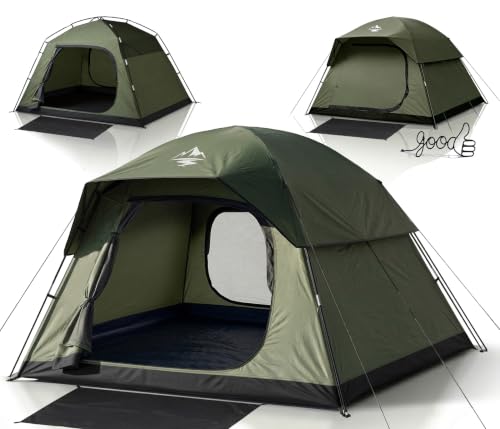
Purebox Tent 4 Person Tents for Camping with 2 Doors & Rainfly

BISINNA 2/4 Person Camping Tent Lightweight Waterproof Backpacking Tent
Clostnature 2 Person Lightweight Backpacking Tent, Camping Tent
Frequently Asked Questions
How much should a lightweight family backpacking tent weigh?
For a 4-person tent, aim for a trail weight under 10 pounds (4.5 kg). For a 6-person tent, aim for under 15 pounds (6.8 kg). The weight can be split among family members, so the per-person weight is often very reasonable.
Are 2-door tents really necessary for a family?
Yes, strongly recommended. Two doors prevent the middle sleeper from being trapped and reduce disruption when someone needs to step out at night. It also provides better ventilation options.
Can I use a 3-season tent for winter camping?
Generally, no. A 3-season tent is designed for spring, summer, and fall. For winter camping, you need a 4-season tent that can handle snow load and high winds. For more on this, see our winter camping guide.
What is the best way to split the weight of a family tent?
A common strategy is for one person to carry the tent body and fly, while another carries the poles and stakes. This distributes the weight evenly. You can also have each child carry their own sleeping bag and pad to lighten the parents' load.