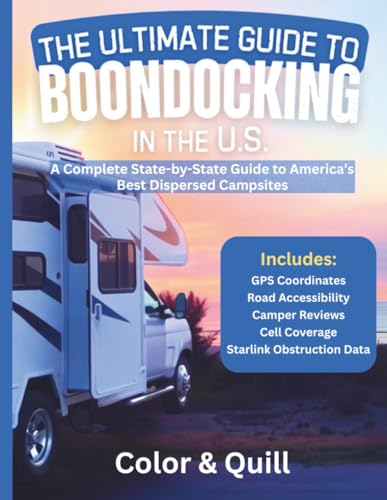
Complete Boondocking Guide: Off-Grid Camping & Dispersed Camping
Discover the freedom of boondocking — camping without hookups on public lands. Learn how to find free campsites, manage your resources, and camp safely off the grid.
What Is Boondocking?
Boondocking, also known as dry camping or dispersed camping, is camping without any utility hookups—no water, no electricity, and no sewer connection [citation:1][citation:2]. It typically takes place in remote or rural areas, often on public lands managed by the Bureau of Land Management (BLM) or the U.S. Forest Service [citation:3][citation:6].
Unlike traditional campgrounds that provide amenities like bathrooms, picnic tables, and water spigots, boondocking is about self-sufficiency. You bring everything you need with you and take everything out when you leave [citation:2].
✅ What Boondocking Is
- Camping without hookups (water, electric, sewer)
- Usually on public lands (BLM, National Forests)
- Often free or low-cost
- Remote, secluded, and connected to nature
- Requires self-contained resources
❌ What Boondocking Is Not
- Camping at developed campgrounds with amenities
- Parking lot overnight stays (e.g., Walmart)
- Staying in someone's driveway ("moochdocking")
- Camping with hookups
Why Boondock? Benefits of Off-Grid Camping
Boondocking offers a unique camping experience that many RVers and tent campers find addictive. Here are some of the top reasons to try it [citation:1][citation:5][citation:9]:
💰 Cost Savings
Most boondocking on public lands is completely free. No campground fees mean more budget for gear and experiences [citation:9].
🌲 Privacy & Solitude
Escape crowded campgrounds. Wake up to stunning landscapes with no neighbors in sight [citation:2].
🗺️ Flexibility
No reservations needed. Camp where you want, when you want, and stay as long as regulations allow [citation:5][citation:9].
🌿 Connection with Nature
True off-grid experience. Disconnect from technology and reconnect with the outdoors [citation:5].
Where Can You Boondock?
The best places to boondock are on public lands managed by federal agencies. However, rules vary by location, so always check before you go [citation:1][citation:3].
🏜️ BLM Land
Bureau of Land Management areas, especially in western states. Typically allows 14-day stays. Check their website for specific rules [citation:3][citation:6].
🌲 National Forests
Dispersed camping is allowed in many national forests. Look for areas outside developed campgrounds [citation:3][citation:6].
⛰️ Wildlife Management Areas
Some WMAs allow camping. Rules vary by state, so check with local wildlife agencies [citation:3].
🗺️ State Trust Lands
Certain states permit dispersed camping on trust lands. Verify regulations before setting up [citation:3].
Stay Limit: Most public lands allow stays of up to 14 days. After that, you typically need to move at least 25 miles away [citation:1][citation:3][citation:9].
How to Find Spots: Use apps like Campendium, The Dyrt, or FreeRoam to find boondocking locations. Always confirm with the managing agency's website before heading out [citation:6][citation:11].
Essential Gear for Boondocking
Boondocking requires careful planning. Here's the gear you'll need to stay comfortable and safe off the grid [citation:3][citation:7][citation:12].
⚡ Power Management
You'll need to generate and store your own electricity. Consider these options [citation:1][citation:12]:
- Portable Power Stations: Store electricity for devices and appliances. A good alternative to generators [citation:1].
- Solar Panels: Recharge your power station during the day. Ideal for sunny locations [citation:3].
- Generators: Provide reliable backup power, but can be noisy. Use sparingly out of respect for other campers [citation:7].
- Lithium Batteries: Lightweight, long-lasting, and more efficient than lead-acid batteries [citation:12].
Pro Tip: Conduct an energy audit before your trip. Identify which appliances you'll use and calculate your daily power consumption [citation:12].
💧 Water & Waste Management
- Fresh Water: Bring enough for drinking, cooking, and washing. A typical rule is 1 gallon per person per day, but you may need more [citation:1][citation:2].
- Wastewater: RVs have gray tanks (sinks/shower) and black tanks (toilet). These fill up quickly, so conserve water and plan for a dump station visit [citation:7].
- For Tent Campers: Bring a portable toilet or know how to properly bury human waste (6 inches deep, 200 feet from water) [citation:7].
🛠️ Tools & Essentials
Boondocking Safety & Etiquette
Boondocking is generally safe, but being in remote areas requires extra precautions [citation:5][citation:7][citation:10].
Safety Tips
- Tell someone your plans: Share your location and expected return time with a trusted contact [citation:7].
- Check weather conditions: A sudden storm can turn a dry road into a mud pit. Know the forecast before you go [citation:10].
- Be wildlife aware: Store food properly to avoid attracting bears or other animals [citation:5].
- Know your vehicle's limits: Check ground clearance and avoid roads that could damage your RV or tow vehicle [citation:7].
- Have an emergency plan: Know the nearest hospital and how to communicate in an emergency [citation:5].
Etiquette for Respectful Camping
- Keep your distance: Set up camp at a reasonable distance from other campers. Give them privacy and quiet [citation:7][citation:10].
- Limit generator use: Run generators only during reasonable hours and turn them off at night [citation:7].
- Leave no trace: Pack out everything you bring in. Leave the site cleaner than you found it [citation:6][citation:7].
- Stay on established roads: Avoid creating new trails that can damage fragile ecosystems [citation:7].
Ready to Start Your Boondocking Adventure?
Boondocking is one of the most rewarding ways to camp. You'll experience nature at its finest, save money, and gain a sense of independence that traditional campgrounds can't match.
Before you go, make sure you have the right gear, know the rules, and practice Leave No Trace principles. With proper preparation, your boondocking trip will be an unforgettable experience.
Start small: Try a one-night stay at a BLM or National Forest spot near you. Learn the ropes, then venture farther off the grid.
Looking for more camping guides? Check out our boondocking camping tips, dispersed camping guide, BLM camping rules, and Leave No Trace principles. Also explore camping FAQ for more answers.